Beyond Borders: How Academic Fellowships and Hybrid Learning Are Cultivating Cross-Cultural STEM Pioneers

In an era where the boundaries of education are expanding beyond traditional classrooms, the fusion of academic fellowships and hybrid learning formats is creating unprecedented opportunities for aspiring STEM leaders. These dynamic pathways are not just reshaping how students learn but also where they learn, enabling a new generation of innovators to thrive in a globally interconnected world. The convergence of these elements is breaking down financial and geographical barriers, making high-quality education accessible to a diverse cohort of learners.
The Rise of Academic Fellowships in a Globalized World
Academic fellowships have long been a cornerstone of higher education, offering students the financial support and resources needed to pursue ambitious academic and research goals. However, their role has evolved significantly in recent years. Today, fellowships are increasingly designed to foster cross-cultural collaboration, providing recipients with the chance to engage in international research projects, attend global conferences, and work alongside leading experts in their fields. Programs like the Fulbright Scholar Program, Chevening Scholarships, and the DAAD (German Academic Exchange Service) are prime examples of how these opportunities are being tailored to cultivate global STEM talent.
What sets modern academic fellowships apart is their emphasis on inclusivity and diversity. Many of these programs actively seek applicants from underrepresented regions and backgrounds, ensuring that the next wave of STEM pioneers reflects a broad spectrum of perspectives. This shift is not just about equity; it’s about enriching the global STEM community with fresh ideas and innovative solutions to some of the world’s most pressing challenges.
Hybrid Learning: The Bridge Between Tradition and Innovation
Hybrid learning formats have emerged as a game-changer in the realm of international education. By blending in-person and virtual instruction, these programs offer students the flexibility to tailor their learning experiences to fit their unique needs and circumstances. For students participating in global undergraduate exchanges or postgraduate studies, hybrid learning eliminates many of the logistical hurdles that once made international education inaccessible. No longer constrained by visa restrictions, travel costs, or rigid academic schedules, learners can now engage with coursework from top universities around the world without leaving their home countries.
Moreover, hybrid learning is fostering a new level of collaboration among students from different cultural and academic backgrounds. Virtual classrooms and collaborative online platforms enable real-time interaction, group projects, and peer-to-peer learning, creating a rich tapestry of ideas and perspectives. This model is particularly beneficial for STEM students, who often work in teams to solve complex problems. By engaging with peers from diverse backgrounds, they gain invaluable insights into different approaches to research, problem-solving, and innovation.
The Role of Cultural Immersion in Shaping Global Citizens
While hybrid learning offers flexibility, the value of cultural immersion cannot be overstated. Academic fellowships that incorporate in-person components—such as study abroad programs, research internships, or cultural exchanges—provide students with firsthand experiences that deepen their understanding of global issues. These immersive experiences are not just about academic growth; they are about developing the soft skills necessary to thrive in a multicultural world. From navigating language barriers to adapting to new social norms, students who participate in these programs emerge with a heightened sense of empathy, adaptability, and cross-cultural communication skills.
For STEM students, cultural immersion also opens doors to unique research opportunities. For example, a student studying environmental science might collaborate with local communities in Southeast Asia to develop sustainable farming practices, or a computer science major could work with a tech startup in Africa to create solutions for digital inclusion. These experiences not only enhance their academic portfolios but also instill a sense of global responsibility and a commitment to using their skills for the greater good.
Financial Aid Packages: Making Global Education a Reality
One of the most significant barriers to international education is the cost. Tuition fees, travel expenses, and living costs can quickly add up, making it difficult for many students to pursue their academic dreams abroad. This is where financial aid packages and merit-based scholarships play a crucial role. Organizations, governments, and universities are increasingly offering comprehensive funding options to support students from all economic backgrounds. These packages often cover not just tuition but also housing, travel, and even stipends for living expenses, ensuring that financial constraints do not hinder academic potential.
Programs like the Erasmus+ initiative in Europe and the Global Undergraduate Exchange Program (Global UGRAD) are exemplary in their efforts to democratize access to international education. By providing fully funded scholarships, these initiatives enable students to focus on their studies and cultural experiences without the burden of financial stress. The impact of such programs extends far beyond individual beneficiaries; they contribute to the creation of a more equitable and inclusive global education landscape.
The Future of STEM Education: A Blend of Innovation and Inclusion
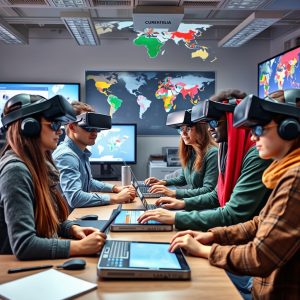
The integration of academic fellowships and hybrid learning is not just a trend; it’s a transformative force in global education. As technology continues to advance, the possibilities for cross-cultural collaboration and innovation will only expand. Virtual reality (VR) and augmented reality (AR) are already being explored as tools to enhance hybrid learning, offering immersive experiences that simulate real-world environments. Imagine a medical student performing virtual surgeries alongside peers from different continents or an engineering student collaborating on a robotics project in a shared digital workspace. The potential for these technologies to revolutionize STEM education is limitless.
Furthermore, the emphasis on educational sustainability is ensuring that these opportunities are not just available but also sustainable in the long term. Universities and organizations are increasingly adopting eco-friendly practices, such as carbon-neutral study abroad programs and digital textbooks, to minimize the environmental impact of global education. This commitment to sustainability aligns with the values of the next generation of learners, who are deeply invested in creating a better future for the planet.
As the world becomes more interconnected, the demand for STEM professionals who can navigate cross-cultural environments and drive innovation will continue to grow. The combination of academic fellowships and hybrid learning is equipping students with the skills, knowledge, and global perspective needed to meet this demand. By breaking down barriers and fostering inclusivity, these programs are not just shaping the future of education; they are shaping the future of the world. The journey beyond borders is just beginning, and the possibilities are as vast as the horizons they open.