Beyond the Classroom: How Blended Education and Cross-Cultural Programs Are Cultivating Global STEM Changemakers

The landscape of higher education is undergoing a seismic shift, propelled by the fusion of technology and globalization. As universities and institutions adapt to the demands of a rapidly evolving world, blended education programs and cross-cultural initiatives are emerging as powerful catalysts for nurturing the next generation of global STEM changemakers. These innovative approaches are not merely redefining how students learn but are also breaking down geographical and financial barriers, making high-quality education accessible to a diverse cohort of learners.
The Rise of Blended Education: A New Paradigm for Learning
Blended education, often referred to as hybrid learning, represents a harmonious marriage between traditional in-person instruction and digital learning platforms. This format has gained unprecedented traction, particularly in the wake of the global pandemic, which accelerated the adoption of online education. However, its benefits extend far beyond mere convenience. Blended education programs offer flexibility, allowing students to tailor their learning experiences to fit their individual needs and schedules. For instance, a student in Nairobi can participate in a virtual lecture delivered by a professor in Berlin, then apply those concepts in a hands-on lab session at a local university.
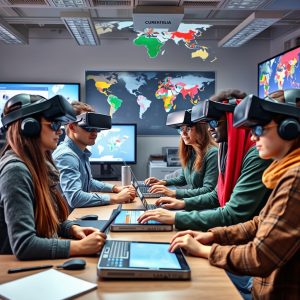
Moreover, hybrid learning formats are proving to be a game-changer for students in STEM fields. The integration of virtual simulations, augmented reality (AR), and artificial intelligence (AI) tools enables learners to engage with complex scientific concepts in immersive and interactive ways. These technologies not only enhance comprehension but also foster creativity and problem-solving skills—qualities that are indispensable for future STEM leaders. As universities continue to refine these programs, the potential for innovation in education becomes boundless.
Cross-Cultural Communication: The Heart of Global STEM Initiatives
At the core of global STEM initiatives lies the principle of cross-cultural communication. Programs such as the Global Undergraduate Exchange and Virtual Student Exchange are designed to expose students to diverse perspectives, fostering a deeper understanding of cultural nuances and global challenges. These experiences are invaluable in an increasingly interconnected world, where collaboration across borders is often the key to solving complex problems like climate change, public health crises, and technological disparities.
For example, a student from India participating in a virtual exchange program with peers in Brazil and Germany might work on a project addressing sustainable energy solutions. Through this collaboration, they not only gain technical expertise but also develop soft skills such as empathy, adaptability, and effective communication—skills that are just as critical as academic knowledge in the professional world. Such initiatives are not limited to undergraduate students; postgraduate funding opportunities and academic fellowships are also expanding to include cross-cultural components, ensuring that researchers and professionals at all levels can benefit from global exposure.
Financial Aid and Scholarships: Breaking Down Barriers to Access
One of the most significant challenges facing students who wish to participate in international or blended education programs is the financial burden. However, a growing number of fully funded scholarships and higher education grants are making it possible for talented individuals from all backgrounds to pursue their academic dreams. Organizations and governments worldwide are recognizing the importance of investing in global talent, particularly in STEM fields, where innovation is critical to addressing pressing global issues.
Merit-based scholarships, such as those offered by the Fulbright Program or the Chevening Scholarships, provide not only financial support but also access to a network of professionals and academics. These scholarships often cover tuition, living expenses, and even travel costs, removing the financial barriers that might otherwise prevent students from participating in global education initiatives. Additionally, many universities are offering their own financial aid packages, including need-based grants and work-study programs, to ensure that no student is left behind due to financial constraints.
Cultural Immersion and Career Development: The Dual Pillars of Success
While academic mobility and blended learning formats provide the foundation for global education, cultural immersion and career development opportunities are what truly transform students into well-rounded, globally competent professionals. Programs that emphasize cultural immersion—whether through in-person exchanges, virtual collaborations, or local community engagement—help students develop a global mindset. This mindset is characterized by an appreciation for diversity, an ability to navigate cultural differences, and a commitment to ethical and sustainable practices.
Career development opportunities, such as internships, research projects, and networking events, are equally vital. Many international scholarships and exchange programs include components that connect students with industry leaders, alumni networks, and potential employers. For instance, a student participating in the Global STEM Changemakers initiative might have the opportunity to intern at a multinational corporation or collaborate on a research project with a leading university. These experiences not only enhance a student’s resume but also provide them with the practical skills and confidence needed to thrive in a competitive global job market.
Educational Sustainability: Building a Future-Proof System
As the world grapples with challenges such as climate change, economic inequality, and technological disruption, the concept of educational sustainability has never been more relevant. Blended education programs and cross-cultural initiatives are playing a pivotal role in creating a more sustainable and equitable education system. By leveraging technology, these programs reduce the need for physical infrastructure, lowering the carbon footprint associated with traditional education models. Additionally, they make education more accessible to students in remote or underserved regions, ensuring that talent is nurtured regardless of geographical location.
Furthermore, the emphasis on cross-cultural communication and global collaboration fosters a sense of shared responsibility among students. When learners from different backgrounds come together to tackle global challenges, they are more likely to develop solutions that are inclusive, innovative, and sustainable. This collaborative approach is essential for building a future where education is not just a privilege for the few but a fundamental right for all.
The transformation of higher education through blended learning and cross-cultural programs is more than just a trend—it is a movement toward a more interconnected, innovative, and equitable world. As students embrace these opportunities, they are not only advancing their own careers but also contributing to a global community of changemakers. The skills they acquire, the perspectives they gain, and the networks they build will shape the future of STEM and beyond, proving that the classroom of tomorrow is not confined by walls or borders, but is as vast and dynamic as the world itself.